Redefining Global Trust: Cynicism and a Case for Being Involved
Reflecting on the Doha Forum 2026 theme: "Redefining Global Trust", why cynicism comes so easily, and the case for staying involved anyway.
 Eric Onuoha9 Nov 20268 min readPersonal Reflections
Getting involved is not the only answer to a crisis of trust, and it is no substitute for institutions doing their part. But it remains one of the most powerful tools ordinary people have, and one we too often set aside.
01 — When headlines become personal
During my university years, I worked one of the student jobs on campus as a library assistant. Part of the role was signing clearance forms. Before graduating, every student had to confirm they had no outstanding books or library debts, a step that released the deposit they had paid when they first enrolled. It was routine work, and usually happy work. People came to the desk at the end of their studies.
One afternoon, a student came in for his clearance. I checked his record, found it clean, looked up with a smile and said, "Congratulations."
He didn't smile back. He looked at me as though he was trying to process what I had just said. After a few seconds, he replied, "No, I'm not done with my studies." We both paused. Then he added, "I have to drop out because of the war in my home country, Yemen."
In the short conversation that followed, he told me his family home had been destroyed. His family had been affected so much that paying for a university degree was simply no longer possible. My heart broke, and there was very little I could say beyond expressing my sympathy. I had read books and articles about war, but none of them had brought it as close, or made it as real, as that student standing across the desk from me, holding a form that marked the end of something he had not chosen to end.
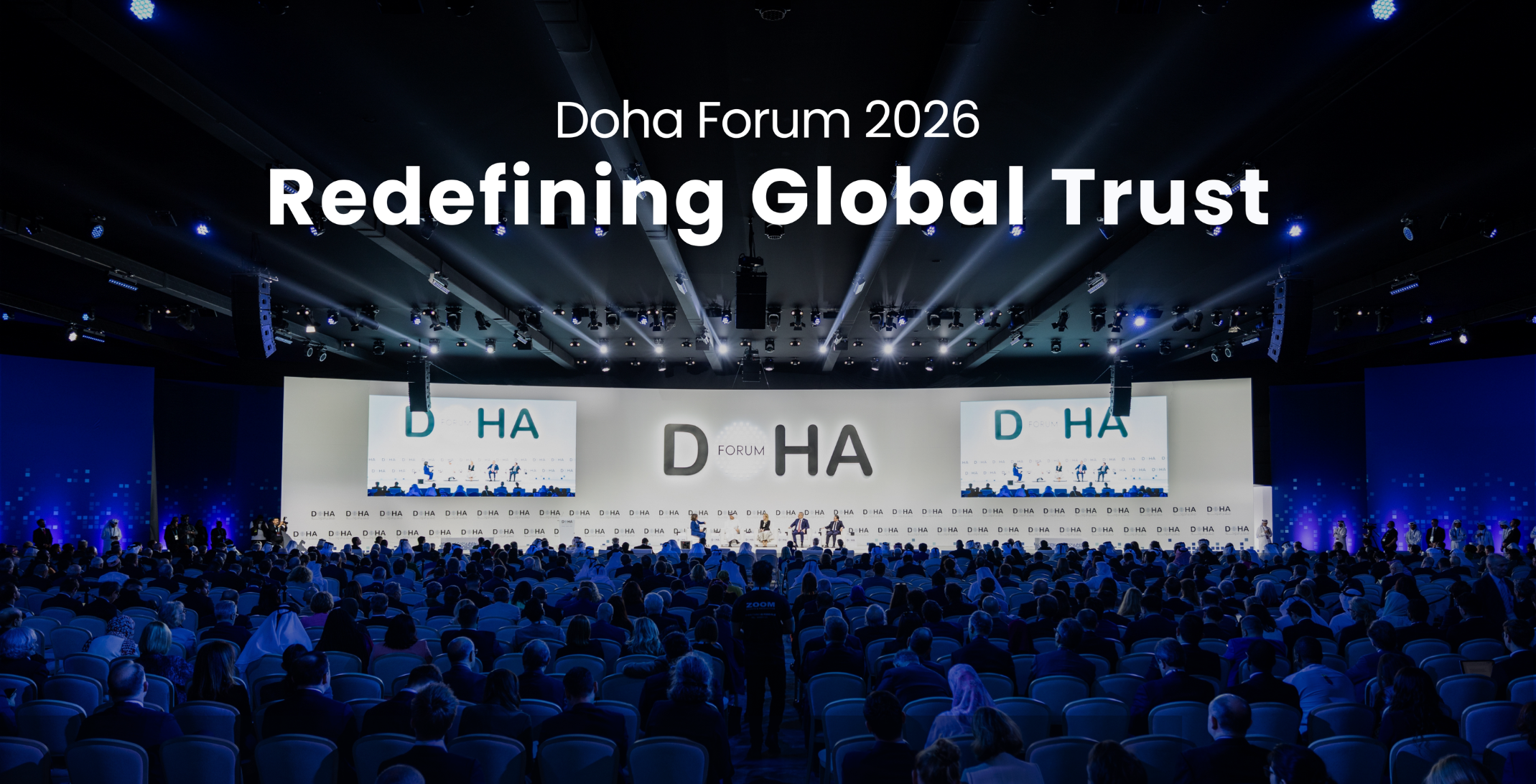
That encounter never left me. It came back to me again recently, while I was completing my application for the Doha Forum 2026, which I have been selected to attend this December.
The 24th edition of the Forum takes place on 5–6 December 2026 in Doha, Qatar, under the theme "Redefining Global Trust." It is a framing worth sitting with for a moment. It is a particularly relevant theme for the times we live in. At a moment of rapid geopolitical change, shifting power dynamics and growing uncertainty, trust in the international system can no longer be taken for granted. Confidence in institutions, international commitments and shared norms is being tested, while technological disruption and competing interpretations of global governance continue to reshape the relationships between countries.
Against this backdrop, the question of trust becomes particularly important. What should we expect from international institutions? How do we reconcile competing national interests with the collective responsibility to maintain global stability? And perhaps more importantly, what happens when the institutions we depend on appear incapable of delivering on the expectations placed upon them?
I want to add one thought to that conversation: the redefinition of global trust starts much closer to home than we tend to assume, and so does one of the most powerful remedies for the cynicism that follows when trust breaks down.
02 — All politics is local
There is a saying that has become very common in Nigerian politics: "All politics is local." Different actors use it for different reasons, but the core idea is that politicians must understand the mood at the grassroots, both to campaign and to govern. What happens at the centre is shaped by incentives and pressures that come up from local structures.
The same is true of international politics. How a country presents itself to the world is, to a large extent, a product of its domestic politics: the kind of leaders its citizens elect, the concerns those leaders carry, and the coalitions they need to keep satisfied at home. A foreign policy is rarely just a foreign policy. It is also an answer to a domestic audience.
International organisations are not immune to this. They are made up of member states, and every member state brings its own local politics to the table. Consequently, the political choices made within individual countries can have consequences far beyond their borders, shaping the conditions under which international cooperation succeeds or fails.
03 — The last resort
What makes this so consequential is that international organisations often become the last resort for communities when things break down locally. For people facing the loss, uncertainty, and despair that come with circumstances beyond their control, whether a family forced to flee their home or a student whose education is cut short by war, these institutions can represent an important source of hope and support.
This creates an interesting contradiction. We look to international organisations for solutions, especially when national and local systems fail. Yet these organisations must operate within a global political system shaped by the very national actors whose actions or inactions may have contributed to the problem.
04 — When strength looks like weakness
We expect international organisations to be bold. We want them to speak out against injustice, condemn violations, hold perpetrators accountable and mobilise action when lives and livelihoods are at stake.
Yet it is often the very qualities that make these institutions effective convening platforms that constrain how they respond to crises. Diplomacy requires tact, negotiation and the ability to keep channels of communication open, even between parties with deeply opposing interests. International organisations must navigate these relationships carefully to preserve their legitimacy, retain access to affected populations and keep the possibility of cooperation alive.
The same restraint that allows an organisation to bring opposing parties to the table can, however, make it appear hesitant or ineffective to those expecting more decisive action. In other words, the strengths of international institutions can become their weaknesses in the eyes of the very people who depend on them.
This is not to suggest that institutions should be absolved of responsibility whenever they fail to act. There are legitimate questions about accountability, effectiveness and whether existing institutional arrangements are adequate for the challenges of today. Nor should diplomacy become an excuse for indefinite inaction, or for deferring to the most powerful member states while the concerns of smaller ones wait. There are moments when an institution has to spend some of its hard-won goodwill: to name what is happening plainly, or to push past hurdles that owe more to convenience than to principle. Recognising those moments is part of the job.
But it is also important to recognise that international organisations do not operate independently of the political realities around them. Their ability to act is often a function of the willingness of countries to cooperate, the interests those countries bring to the negotiating table and the compromises they are prepared to make.
05 — Cynicism and the cost of standing aside
Cynicism and disengagement can reinforce one another. But perhaps what makes cynicism particularly unfortunate is that it often comes from a place of genuine concern. It takes some level of hope, expectation or belief in the possibility of change to feel disappointed when it does not happen. A breakdown of trust often begins with expectations that were once held but eventually left unmet. The people who become most disillusioned are not necessarily those who never cared, but often those who cared enough to want things to be different. And sometimes, those who feel most defeated are precisely the people with the capacity to contribute to making that change.
It is easy to look at a stalled resolution or a delayed humanitarian response and conclude that the system is beyond repair, and that ordinary people have no part in fixing it. That is exactly what cynicism tells us. But if all politics is local, then so is a meaningful part of the solution, though not necessarily in the place most in need. It lies just as much in other countries with competing interests: in what their citizens demand, in what their leaders believe they can justify at home, and in what they are willing to concede for the sake of a settlement somewhere else.
Diplomacy assumes a world of rational actors, each pursuing its interests within a shared set of rules. When that assumption breaks down, when leaders are rewarded at home for intransigence, or the rules themselves are in dispute, suffering is prolonged, and trust erodes further. Repairing it will take many things, from reform of the institutions themselves to better diplomacy and sustained pressure from those most affected. But it also depends, in no small part, on the domestic politics of many countries producing leaders who see value in cooperation, and on citizens prepared to hold both their own governments and international institutions to account.
Trust in international cooperation will not be redefined only in Doha, Geneva, or New York. It will also be redefined by the leaders citizens choose and the questions they ask. The student at the library desk and families waiting for help in places far from any negotiating table depend on those choices in ways that are hard to trace but entirely real.
Getting involved is not the only answer to a crisis of trust, and it is no substitute for institutions doing their part. But it remains one of the most powerful tools ordinary people have, and one we too often set aside.
Engagement can take many forms. It can mean participating in politics and civic initiatives at the national level, supporting advocacy and public-interest efforts, or contributing directly to the work of international organisations. It can also mean bringing different perspectives and experiences into the institutions and processes where decisions are made, with the understanding that meaningful change is often gradual. None of these efforts guarantees immediate results, but collectively they help shape the political and institutional environments in which cooperation, accountability and progress become possible. It is a case I hope to carry with me to Doha.